

A Delhi to Leh road trip is not simply a long drive north. It is a transition from the plains into one of the highest inhabited regions on Earth, and the route you choose changes the altitude profile, the scenery, the number of days you need, the fuel strategy and how tired you are when you finally reach Leh.
There are two classic road approaches: Delhi → Manali → Leh and Delhi → Srinagar → Kargil → Leh. The Manali side is shorter from Delhi and enters the high plateau dramatically, but it gains altitude quickly. The Srinagar side is longer from Delhi, yet the rise through Kashmir, Drass and Kargil is more gradual. For travellers who want to experience both highways, a practical circuit is Delhi → Srinagar → Kargil → Leh, then Leh → Manali → Delhi, because the gentler road approach comes first and the higher Manali highway is driven after time in Ladakh.
This guide explains the complete journey by car, motorcycle, bus and air, with realistic stage planning, altitude considerations, seasonal access, fuel, permits, vehicle questions, packing, communication, family considerations and the mistakes that turn a great Himalayan road trip into an exhausting one.
Delhi to Leh at a glance
| Option | Typical route | What to expect |
|---|---|---|
| Via Manali | Delhi → Chandigarh → Manali → Atal Tunnel → Jispa → Sarchu/Pang → Leh | Usually around 950–1,050 km from Delhi depending on the exact routing. Shorter overall, spectacular, but with rapid altitude gain and long remote sections. |
| Via Srinagar | Delhi → Jammu → Srinagar → Sonamarg → Drass → Kargil → Lamayuru → Leh | Longer from Delhi, but the altitude increases more gradually. Better suited to travellers who want a slower approach to Leh. |
| Grand circuit | Delhi → Srinagar → Leh → Manali → Delhi | Uses both highways and avoids repeating the same road. Allow enough days rather than treating it as a race. |
| Fly | Delhi → Leh | Fastest. The sudden jump to about 3,500 m makes acclimatization in Leh especially important. |
| Seasonal bus | Delhi / Manali / Keylong → Leh | Budget-friendly and memorable, but highly seasonal and dependent on road conditions and the operating timetable. |
Quick planning answer: if this is your first overland Ladakh journey and you have enough time, entering through Srinagar and leaving through Manali is often the more comfortable sequence. If you have already acclimatized or are travelling from the Himachal side, the Manali route can work well when broken into sensible stages.
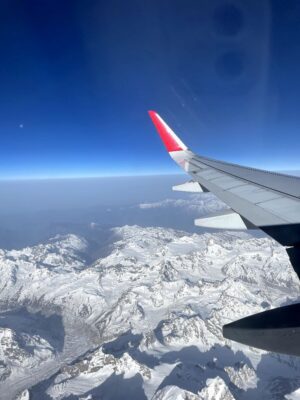
The two road approaches are not the same trip
Maps make the two approaches look like alternative lines to the same destination. On the ground they feel completely different. The Srinagar road enters Ladakh through the Kashmir side, crossing Zoji La before reaching Drass and Kargil. The Manali road climbs through Himachal Pradesh and Lahaul before crossing a succession of very high passes and the exposed plateau between Sarchu, Pang and the More Plains.
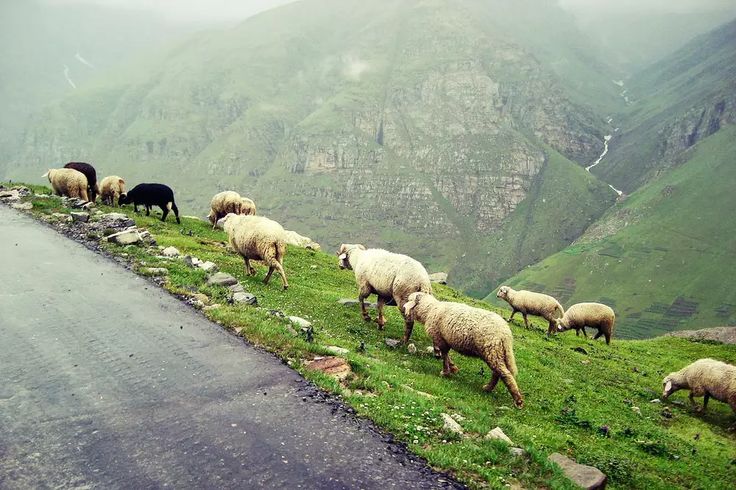
The District Leh administration currently lists three road approaches to Leh: the Srinagar–Leh Highway, the Manali–Leh Highway, and the newer Manali–Keylong–Darcha–Zanskar–Nimoo connection. Its public guidance lists approximately 434 km from Srinagar to Leh and 473 km from Manali to Leh on the traditional highway description. Modern through traffic from Manali normally uses the Atal Tunnel to enter Lahaul, so real navigation distances can differ from older Rohtang-based figures.
Route 1: Delhi to Leh via Manali and the Atal Tunnel
The practical modern Manali–Leh journey normally uses the Atal Tunnel to enter Lahaul. Many older guides still describe Rohtang Pass as part of the normal through-route. Today, travellers heading directly toward Leh generally use the tunnel unless they intentionally make a separate Rohtang excursion under the local rules in force at the time.
The high-mountain sequence is approximately:
Delhi → Chandigarh → Mandi → Kullu → Manali → Solang → Atal Tunnel → Sissu → Tandi → Keylong → Jispa → Darcha → Baralacha La → Sarchu → Gata Loops → Nakee La → Lachulung La → Pang → More Plains → Tanglang La → Upshi → Leh.
Why the Manali route feels harder
Manali is only around 2,000 m above sea level. Within a relatively short period after leaving it, the highway moves through sleeping areas above 3,000 m and several road passes approaching or exceeding 5,000 m. The road may be open and the vehicle may be running perfectly while the human body is still struggling to adapt.
This is why a one-day Manali-to-Leh dash is a poor planning benchmark for most travellers. A driver may be physically capable of staying behind the wheel for that long, but driving endurance is not the same thing as altitude adaptation.
A practical Manali-side staging plan
| Stage | Approximate altitude | Planning logic |
|---|---|---|
| Manali | ~2,000 m | Final major town before Lahaul; vehicle checks, cash and supplies. |
| Keylong / Jispa | ~3,000–3,200 m | More conservative first high-altitude night than Sarchu for many travellers. |
| Sarchu | ~4,290 m | Convenient geographically but very high for an early sleeping altitude. |
| Pang | ~4,600 m | High and exposed; usually a transit or meal stop rather than an early acclimatization night. |
| Leh | ~3,500 m | Destination and base for further acclimatization before higher side trips. |
For many first-time travellers, Manali → Jispa/Keylong → Leh is preferable to choosing Sarchu simply because it divides the kilometres neatly. An extra night does not guarantee protection from altitude illness, but avoiding an unnecessarily high first sleeping stop can make the itinerary more conservative.
The high passes on the Manali–Leh highway
- Baralacha La: roughly 4,890 m.
- Nakee La: roughly 4,700 m.
- Lachulung La: around 5,000 m.
- Tanglang La: above 5,300 m on commonly quoted measurements.
Route 2: Delhi to Leh via Srinagar and Kargil
The Srinagar route is longer from Delhi, but it rises in a more progressive sequence:
Delhi → Jammu → Srinagar → Sonamarg → Zoji La → Drass → Kargil → Mulbekh → Namika La → Fotu La → Lamayuru → Khaltse → Nimmu → Leh.
The official Leh district guidance lists the Srinagar–Leh highway at about 434 km from Srinagar to Leh. The classic split is Srinagar to Kargil, then Kargil to Leh.
Why this route is often easier for acclimatization
Srinagar lies far lower than Leh. From there the road crosses Zoji La, drops toward Drass, and reaches Kargil before the second day continues over Namika La and Fotu La toward Lamayuru and Leh. The ascent is not medically risk-free, but it is generally less abrupt than moving from Manali directly into the very high plateau beyond Baralacha La.
Suggested Srinagar-side stages
| Day | Stage | Why it works |
|---|---|---|
| 1 | Delhi → Jammu or another suitable break | Avoid starting the mountain section exhausted. |
| 2 | Jammu → Srinagar | Enter Kashmir and sleep at a moderate altitude. |
| 3 | Srinagar → Sonamarg → Drass → Kargil | Cross Zoji La and end the day in a major service town. |
| 4 | Kargil → Mulbekh → Lamayuru → Nimmu → Leh | Scenic and culturally rich final approach to Leh. |
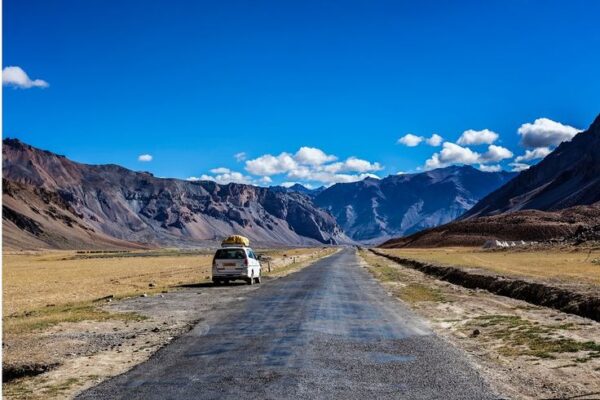
Which direction should you drive?
If you want to use both highways, the sequence Srinagar in, Manali out has a practical logic: the road gains altitude more gradually on the way into Leh, you spend several days acclimatizing in Ladakh, and only then do you tackle the high Manali highway on the return.
That does not make the reverse direction wrong. Travellers arriving from Himachal, people who have already spent time at altitude, or itineraries built around Zanskar may have good reasons to enter from Manali. The important point is to design the route around the traveller, not around a screenshot of somebody else’s itinerary.
How many days from Delhi to Leh?
There is a major difference between what is mechanically possible and what produces a good trip.
Balanced Manali approach
- Day 1: Delhi → Manali.
- Day 2: Manali → Keylong / Jispa.
- Day 3: Jispa → Leh, with an early start and realistic stops.
- Day 4: easy day in Leh rather than immediately rushing to another high pass.
Balanced Srinagar approach
- Day 1: Delhi → Jammu or another break point.
- Day 2: continue to Srinagar.
- Day 3: Srinagar → Kargil.
- Day 4: Kargil → Leh.
Complete Delhi–Ladakh circuit
If you also want Nubra Valley, Pangong, Tso Moriri or Hanle, do not confuse “days to reach Leh” with “days for Ladakh.” A relaxed full circuit from Delhi can easily need 10–14 days or more, depending on which side trips are included and how many buffer days you keep for weather, road work or health.
Altitude is the real route planner
The most useful way to compare Delhi-to-Leh itineraries is not by kilometres; it is by sleeping altitude. The body adapts primarily to where you spend hours resting and sleeping, not to how quickly your vehicle can cross a pass.
This is why an itinerary that looks efficient on a spreadsheet can be physiologically aggressive. Manali to Sarchu is a good example: the distance is manageable, but Sarchu is above 4,000 m. For a traveller who was sleeping near 2,000 m the previous night, that jump can be uncomfortable.
Delhi to Leh by air
Flying is the fastest option and the right choice for many travellers with limited time. Delhi–Leh flights can put you at roughly 3,500 m in little more than an hour of flight time, which is exactly why the first days must not be overloaded.
The District Leh administration states that tourists arriving in Leh should undergo at least 48 hours of acclimatization before travelling to higher-altitude areas such as Khardung La and Pangong. Nearby parts of Leh town may be visited during that period, but feeling fine on arrival is not a reason to race straight to another high pass.
Delhi to Leh by bus
Seasonal public bus travel is one of the most memorable low-cost ways to cross the Manali–Leh corridor, but it should never be treated as a year-round service. The exact start and end dates can change with road clearance, weather, traffic restrictions and the operator timetable.
Before buying onward hotels around a bus plan, confirm the actual operating date with the current transport operator. Bus travel removes the responsibility of driving, but it does not remove altitude exposure, long sitting hours or weather delays.
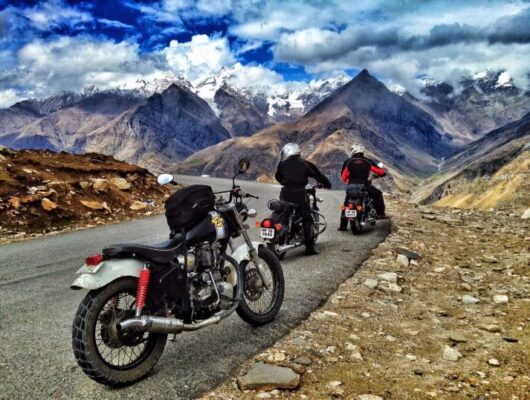
Delhi to Leh by motorcycle
A motorcycle makes the road feel immediate: temperature, wind, water crossings and surface changes are experienced directly. That is exactly why the preparation standard should be higher, not lower.
- Service the motorcycle before leaving the plains.
- Carry puncture-repair equipment and know how to use it.
- Inspect tyres, brake pads, chain, clutch cable and charging system.
- Use waterproof luggage and keep electronics isolated from water.
- Do not plan daily distances using normal highway averages.
- Start early on high-road days so you are not forced into night riding.
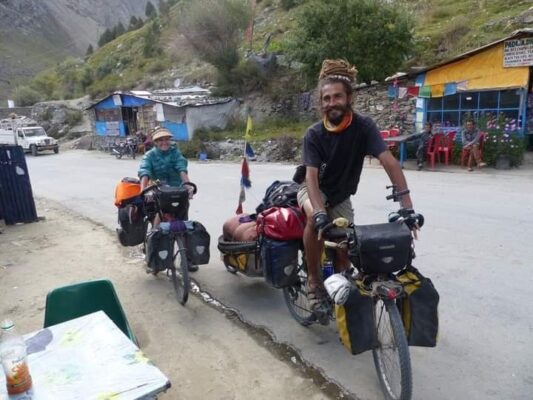
What about cycling from Delhi to Leh?
Cycling to Leh is a serious endurance expedition, not simply an eco-friendly option. The challenge is not only total distance; it is repeated climbing, extreme altitude, traffic, cold, wind, limited resupply and recovery.
Fuel: the section that punishes casual planning
The Manali–Leh highway has a famously long fuel gap beyond the Lahaul side. Exact pump status and temporary fuel availability can change, so do not plan to the last litre based on an old blog.
- Refuel fully before the long remote section.
- Confirm the current operating status of the next reliable pump the same day.
- Know your vehicle’s realistic mountain fuel consumption, not the brochure figure.
- Carry reserve fuel only in a safe, legal container suitable for the vehicle and route.
Vehicle choice: do you need a 4×4?
A capable 4×4 is useful when conditions deteriorate, but four-wheel drive is not a magic shield against poor judgement. Many standard high-clearance vehicles complete the main highways in normal summer conditions. Tyres, ground clearance, driver experience, load, weather and recent road damage matter just as much.
Personal car versus outside rental vehicle
Do not assume that an outside rented self-drive vehicle can automatically be used for every local sightseeing circuit after you reach Leh. Local transport practices and enforcement around outside rental vehicles have changed and have been contested over time. If you are bringing a rental from Delhi, Chandigarh, Srinagar or Manali and intend to continue to Nubra, Pangong, Tso Moriri or Hanle, confirm the current arrangement before paying for the rental.
Permits: highway access versus restricted-area sightseeing
Driving the main highway to Leh and visiting restricted or protected areas inside Ladakh are different questions. Do not use “I reached Leh without a permit” as evidence that no permits are needed for your next destination.
Requirements vary by nationality and destination, especially for northern and eastern Ladakh. The permit framework is actively reviewed by the Ladakh administration, so current official information should override a screenshot, forum post or old itinerary. LOTPL checks the applicable requirements for guests based on their actual route and nationality.
Best season for a Delhi to Leh road trip
The two highways do not have identical seasons. The District Leh administration currently describes the Srinagar–Leh road as generally open from around May toward November or December, while the Manali–Leh highway usually operates from around May/June into September/October.
Those are seasonal patterns, not guarantees. A highway can be open for the season and still close temporarily for snow, landslides, road work, water crossings, accidents or traffic control.
Road status: what to check the day before
- Whether the highway is officially open.
- Whether one-way traffic windows or convoy controls apply.
- Whether a pass has a temporary weather closure.
- Whether buses are operating, if you depend on public transport.
- Whether your intended fuel and overnight stops are actually open.
Mobile network, cash and offline navigation
- Download offline maps before leaving reliable internet.
- Save hotel and operator phone numbers offline.
- Carry enough cash for remote food, rooms or minor repairs.
- Keep copies of identification and permits accessible offline.
- Tell someone your next overnight stop before entering a long no-signal section.
Responsible driving matters more in 2026
Stay on established roads and legal tracks. In June 2026 the Ladakh administration imposed a total penalty of ₹2 lakh on four vehicle owners for illegal off-road driving in protected wildlife areas including locations around Pangong, Hanle and Nubra; the vehicles were impounded until the penalties were paid. In July 2026, 12 motorcycle riders were also fined for illegal off-road riding near Tso Moriri, and another SUV driver was penalised near Pangong.
A photograph of a vehicle in a lake, wetland or wildlife habitat is not an adventure achievement. It can damage fragile habitat and lead to legal action. If a line on the ground is not clearly an established legal road or track, do not create one.
Travelling with children or older family members
A road trip may look easier than trekking, but altitude does not care whether you arrived on foot or in a comfortable SUV. Very young children, older travellers and people with relevant medical conditions need an itinerary built around their individual health, sleep, appetite, mobility and tolerance for long drives.
- Consider entering through Srinagar rather than using the fastest Manali ascent.
- Shorten driving days.
- Add a rest day in Leh.
- Skip a very high overnight if it adds unnecessary exposure.
- For air arrivals, build the official 48-hour acclimatization period into the itinerary.
What to pack in the vehicle
- Warm insulated layer, even in summer.
- Windproof or water-resistant shell.
- Sun protection: sunglasses, sunscreen, hat and lip balm.
- Personal medication and first-aid basics.
- Water and high-energy snacks.
- Offline maps and charging power bank.
- Tyre inflator, puncture kit and basic tools.
- Spare key stored separately.
- Paper and digital copies of important documents.
- Emergency cash and waste bags.
Common mistakes on the Delhi to Leh route
1. Treating the trip as a distance challenge
The question is not “Can I drive 700 km in a day?” but “What altitude will I sleep at after that drive, and what happens if the road closes?”
2. Sleeping at Sarchu because it looks perfectly halfway
Geographically convenient does not automatically mean physiologically conservative. Sarchu is above 4,000 m.
3. Using an old Rohtang-based Manali itinerary without checking the Atal Tunnel route
The modern through-route has changed. Make sure the guide you are following reflects the road you will actually drive.
4. Assuming seasonal bus timetables are permanent
High-altitude bus service starts and stops according to the road season. Confirm the exact operating day.
5. Believing every rental vehicle can do every local Ladakh circuit
Confirm current local transport practices before committing to an outside rental vehicle.
6. Carrying no buffer day
One closure can affect a flight, hotel, permit date or the next high-road sector. A buffer day is part of the itinerary, not wasted time.
7. Driving off-road for photographs
This is environmentally damaging and can result in fines, vehicle seizure or prosecution in protected areas.
Delhi to Leh route decision guide
| If your priority is… | Consider… |
|---|---|
| More gradual road ascent | Srinagar → Kargil → Leh |
| Classic approach from the Himachal side | Manali → Atal Tunnel → Jispa → Leh |
| Experiencing both highways | Srinagar in, Manali out |
| Minimum travel time from Delhi | Fly to Leh, then follow the 48-hour acclimatization guidance |
| Lowest-cost overland experience | Seasonal public bus, if currently operating |
| Photography with flexibility | Private car or taxi with buffer days and shorter stages |
Frequently asked questions
How far is Delhi to Leh by road?
It depends on the route. The Manali approach is commonly around 950–1,050 km from Delhi in practical routing, while the Srinagar approach is longer. Do not choose only by total kilometres; altitude profile and overnight stops matter more.
Can Delhi to Leh be driven in two days?
A very fast transit may be mechanically possible in some conditions, but it is not a sensible default plan for most first-time travellers. Long driving hours and rapid altitude gain create avoidable risk and fatigue.
Is Manali to Leh open all year?
No. It is a seasonal high-altitude highway. Typical operating months are in the warmer part of the year, but exact opening and closing dates vary.
Is Srinagar to Leh open all year?
No, although it commonly has a longer road season than the Manali route. Snow and temporary closures can still interrupt access.
Which route is better for a first Delhi to Leh road trip?
If you have enough days and want both highways, the Srinagar-in / Manali-out sequence often makes sense because the approach to Leh is more gradual. Personal health, road status and the rest of your itinerary still matter.
Do I need a permit just to drive to Leh?
The main highway journey to Leh is different from visiting restricted or protected destinations after arrival. Permit requirements depend on the places you plan to visit and your nationality. Check the current official framework for the actual itinerary.
Do I need a 4×4?
Not necessarily for the main highways in normal operating conditions. Ground clearance, tyres, maintenance, driving skill and current road condition can matter as much as four-wheel drive.
Can I take a Delhi rental car to Nubra and Pangong?
Do not assume so. Outside rental vehicles have faced local operational restrictions for sightseeing beyond Leh. Confirm the current arrangement before booking the vehicle.
Is there a direct Delhi to Leh bus?
Seasonal long-distance bus service has operated on the Delhi–Keylong–Leh corridor, but it is not year-round. Check the current transport operator timetable for your exact travel date.
What is the biggest mistake first-time drivers make?
Planning around distance instead of altitude. A neat-looking daily mileage table can place you at an unnecessarily high sleeping altitude before your body has adapted.
Final planning principle
The best Delhi to Leh journey is not the one with the fewest days or the greatest number of high passes. It is the one that gives you enough time to notice the transition: plains becoming foothills, foothills becoming valleys, valleys opening into the high plateau, and finally the Indus carrying you into Leh.
Build the itinerary around altitude, current road conditions and human energy. Keep a buffer day. Refuel early. Stop before exhaustion. Let weather change the plan when it needs to. And once you reach Ladakh, treat the landscape as a place people and wildlife live in—not as an obstacle course for a vehicle.